AI Automation ROI: How to Estimate Savings Before You Build
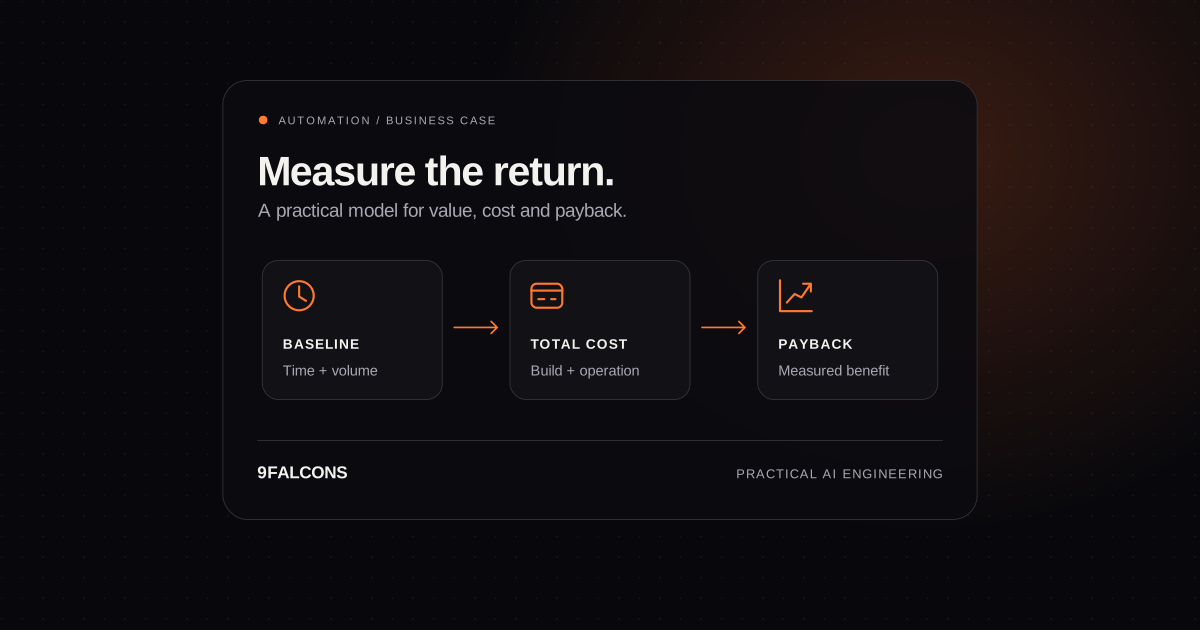
Build an automation business case from measured work, realistic review time and full ownership costs. This worked example shows the maths and its limits.
The useful question is not whether AI can perform a task. It is whether changing that process is worth the cost and operational effort. An automation business case should survive a busy month, imperfect inputs and the time people still spend checking the work. Begin with a baseline, then test the assumptions in a small pilot.
Measure the process before estimating the savings
Pick a completed unit of work: a qualified enquiry, validated invoice or resolved support request. Count how many reach completion each month and observe the active work needed per item. Do not count a two-day wait for approval as two days of paid labour. Record rework and review separately so they do not disappear from the proposed future process.
- Volume: completed items in a normal month and in a peak month, split by common and unusual cases.
- Baseline effort: active handling time, quality checks, corrections and recurring reporting.
- Future effort: remaining review, exception handling, monitoring and maintaining the workflow.
- Costs: implementation, onboarding, platform fees, infrastructure, AI usage and support.
- Quality: an outcome measure such as correct records or appropriately routed enquiries, rather than just successful API requests.
Use a simple model you can explain
| Measure | Calculation |
|---|---|
| Baseline hours | Monthly completed items x baseline minutes per item / 60 |
| Remaining hours | Monthly completed items x future minutes per item / 60 |
| Hours released | Baseline hours minus remaining hours |
| Capacity value | Hours released x fully loaded hourly labour cost |
| Net monthly benefit | Monthly benefit minus recurring ownership costs |
| Simple payback | One-time implementation cost / net monthly benefit, when positive |
Use consistent units and avoid double counting. If the future minutes-per-item figure already includes review, do not deduct the same review effort a second time. Include a separate allowance for administration that is not tied to an individual item. If monthly costs exceed the estimated benefit, the project has no positive simple payback under those assumptions.
Worked example: a document-handling workflow
The following is a hypothetical planning example, not a result from a 9Falcons client. Assume 2,000 documents each month, six minutes of baseline effort per document and two minutes after automation, including average review and exceptions. That changes monthly effort from 200 hours to approximately 66.7 hours, releasing around 133.3 hours.
At a fully loaded labour cost of $30 per hour, the released capacity is worth approximately $4,000 a month. With $600 in recurring ownership costs, the estimated net monthly capacity value is $3,400. If implementation costs $6,800, simple payback is two months after reaching that operating level. Ramp-up, internal project time and any additional costs would extend it.
Over twelve months at that steady volume, gross capacity value would be $48,000. Subtract $7,200 in recurring costs and the $6,800 implementation cost to get $34,000 in net value. Dividing $34,000 by the $14,000 total cost gives approximately 243% ROI. This is a capacity-value calculation, not a prediction of cash profit, and assumes the new process operates for the full twelve months.
Saved capacity is not automatically cash saved
If the same people remain on payroll, the immediate benefit is time they can use elsewhere. Describe it as capacity released unless there is an actual reduction in overtime, contractor spend or another cash cost. A capacity-based return can still justify a project, but only if the business has useful work for those hours.
Likewise, faster follow-up is not automatically additional sales. Track whether it changes qualified conversations and won business. If you model new revenue, use incremental contribution after delivery costs and keep it separate from the labour calculation. Our lead qualification guide explains what to measure across that handover.
Test a conservative scenario before approving the build
| Scenario | Hours released / month | Net monthly capacity value | Simple payback |
|---|---|---|---|
| Conservative | 60 | $1,200 | About 5.7 months |
| Base | About 133.3 | About $3,400 | About 2 months |
| Higher benefit | 160 | $4,200 | About 1.6 months |
Change volume, review effort and running costs independently. A low-volume workflow can fail to justify an ambitious build even if the technical demonstration is impressive. Poor source data may make the review queue larger than expected. For each assumption, write down how a pilot will confirm it rather than hiding uncertainty inside a single confident percentage.
Define the pilot's acceptance measures
- 01Choose one process owner and a representative sample that includes ordinary work, missing information and difficult exceptions.
- 02Record the manual baseline using the same definition of completed work that the automated process will use.
- 03Run with review or in shadow mode first. Compare quality, completion time, review effort and cost per item.
- 04Document failures and recovery work. A fast workflow that silently loses items does not deliver the claimed benefit.
- 05Review the measured result with the owner, then decide whether to expand, change the approach or stop.
What our client projects show, and what they do not
Our AI email automation project removed 30+ hours of manual email work each week for a US B2B team. Our document-processing project processed 80% of documents without manual entry for a Canadian logistics provider. These are outcomes for those particular implementations, not assumptions to copy into another company's ROI model. Neither figure should be treated as an accuracy score or a promise for a new project.
For your own business, start with the process that has a clear owner, enough repeat volume and accessible data. Our AI automation service covers connected workflows; our AI agent development service covers tasks that need tool use and decisions within defined limits. The n8n cost guide helps you account for implementation and ownership before you discuss a pilot with us.
Frequently asked questions
What is a good ROI for AI automation?
There is no universal threshold. Compare the project with your own investment requirements, operational risk and alternatives. Estimate a conservative case and verify quality, review time and costs in a pilot before expanding.
How do you calculate automation payback?
Divide the one-time implementation cost by positive net monthly benefit. Include recurring costs and remaining human work. Account for ramp-up if the workflow will not immediately reach its expected volume and performance.
Does AI automation always reduce payroll costs?
No. Releasing staff time usually creates capacity first. It becomes a cash saving only when it changes an actual expense, such as overtime or contractor work. Keep capacity value and cash savings separate.
What if the pilot does not show a positive return?
Review the scope, volume, data quality and operating costs. A simpler rules-based integration may be more suitable, or another process may offer a better opportunity. The purpose of a pilot is to inform that decision before a larger investment.